The Growing (Relative) Wealth of the NHL's Upper-Middle Class
With Labor Day just passed and hockey season less than a month away, let's take a moment to reflect upon the biggest labor story of the NHL's offseason: the initial rejection, and subsequent contingent-on-a-CBA-amendment acceptance of a revised contract for Ilya Kovalchuk to play for the New Jersey Devils. As one would expect, the entire saga, particularly the ultimate rule-shifting decision, has resulted in a significant amount of discussion and debate among NHL pundits and fans.
Of course, no one's more impacted by changes to the collective bargaining agreement than the players themselves, which is why it made sense that new Los Angeles King and player union representative Willie Mitchell had some thoughts on the issue. Mitchell told The Province, "We have a big gap in our union where you have the star player and the blue-collar player. All those top-end guys are getting paid more and more and the bottom-end guys are getting less and less. Maybe if we come to something more level, it might help the rest of our union."
For this, Province writer Tony Gallagher took Mitchell to task, labeling the defenseman a "socialist" and making light of the Grade II concussion that ended Mitchell's season in January. Classy. (For his efforts, Gallagher was given an exhaustive smakedown courtesy of Jewels from the Crown, which I highly recommend.)
What Gallagher didn't do in his piece was examine whether or not Mitchell's claim was, you know, correct; whether or not the NHL's existing financial structure overwhelmingly favors the league's elite players, or favors those players more than the pre-salary cap financial structure. That's what we decided to take a look at, after the jump.
Using USA Today's salary database, we decided to look at salary distribution for the 2009-10 NHL season, as well as for 2003-04 - the last year before the lockout. Here's what we found:
| 2003-04 | Mean | 10th Pct. | 25th Pct. | 50th Pct. | 75th Pct. | 90th Pct. | 95th Pct. | Gini* |
| Salary | $1,780,768 | $450,000 | $600,000 | $1,100,000 | $2,200,000 | $4,200,000 | $5,848,805 | .480 |
| % of Mean | 100.0 | 25.3 | 33.7 | 61.8 | 123.5 | 235.9 | 328.4 | - |
| % of Median | 161.9 | 40.1 | 54.5 | 100.0 | 200.0 | 381.8 | 531.7 | - |
| Share of Total | - | 2.2 | 6.6 | 18.2 | 39.1 | 64.1 | 77.9 | - |
| 2009-10 | Mean | 10th Pct. | 25th Pct. | 50th Pct. | 75th Pct. | 90th Pct. | 95th Pct. | Gini* |
| Salary | $2,211,550 | $550,000 | $735,000 | $1,300,000 | $3,475,000 | $5,112,500 | $6,390,000 | .456 |
| % of Mean | 100.0 |
24.9 |
33.2 |
58.8 |
157.1 |
231.2 |
288.9 |
- |
| % of Median | 170.1 | 42.3 | 56.5 | 100.0 | 267.3 | 393.3 | 491.5 |
- |
| Share of Total | - | 2.3 | 6.6 | 16.9 | 42.8 | 70.1 | 83.1 |
- |
[Ed note: The Gini coefficient is measure of dispersion that compares actual wealth or income distribution with a hypothetical perfect equality scenario. Ratios approaching 1 (or 100, depending on how it's written) are more unequal, while ratios approaching zero are more equal, with zero itself representing perfect equality.]
For the NHL's "working class," not much has changed. The relationship between the the salary of players in the 10th and 25th percentiles to the league's mean and median isn't all that different; the share of the total amount paid out to players in the 10th and 25th percentiles is almost identical. The "middle class" - the 50th percentile - appears to be slightly worse off (since we see the 25th percentile's share holding constant but the 50th percentile's dropping a bit), but whether it's enough of a difference to account to a trend is debatable. Yet the Gini coefficient was lower in 2009 than 2003 -- why?
The answer is that the NHL's elite aren't getting nearly as high a percentage of the overall salary pie as they were in 2003. Salaries of the top five percent of NHLers dropped significantly in relation to both the League mean and median, and the same group saw its share of the total amount paid out drop from 22.1% to 16.9% (i.e. the bottom 95% of NHL players saw its share increase from 77.9% to 83.1%).
Most of the benefit seems to have gone to what could be considered the NHL's upper-middle class -- players who make more than most of their peers, but aren't in the upper echelon. For example, players in the 75th percentile saw their pay jump relative to the League mean and median jump from 124% and 200% to 157% and 267%, respectively. The higher percentages of total salary paid out in the 75th and 90th percentiles with equal or lower payouts for players at or below the median suggests that most of the money that was being paid out to the truly elite (salary-wise) players in 2003 is now being paid to players in the next tier or two, but isn't quite trickling down to the masses. Visually, it looks something like this:
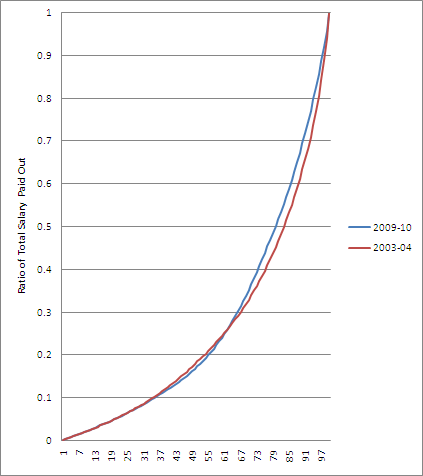
To think of it another way, imagine a tubular balloon being squeezed a bit at the midway point towards the top and a bit from the top. The resulting bulge in between? That's (more or less) your 75th percentile.
What that means is that, although pay in the NHL could probably be considered more equal in today's NHL that in 2003, most NHLers aren't seeing that much of a benefit and, in fact, the league's "middle class" may be worse off than they were before. Now, that doesn't necessarily mean that Gallagher's point that the league's best players are the ones hurt most by the current CBA is incorrect -- but maybe it does mean Willie Mitchell's not all that crazy.
23 comments
|
23 recs |
Do you like this story?
Comments
Rec'd.
Have I said yet how much I love DMG articles? I have? Well fuck you then.
"#DCU is like senior prom. A bunch of people standing around waiting for a 17-year old to score."
by Bald Pollack on Sep 10, 2010 11:42 AM EDT reply actions 5 recs
Also Rec'd
Fantastic article. Thanks for taking the time to do the research on this.
by J.J. from Kansas on Sep 10, 2010 11:44 AM EDT reply actions
Wow, great post. Nice application of the Gini coefficient and understanding of it’s limitations.
One thing that is very difficult to consider in this case is term of contract. I could see “middle class” NHLers who are signed to 1-3 year deals feeling that they are disadvantaged since the new NHL signs the “rich” players to longer contracts. There are very few examples of mid range players with longer deals, and missing out on the added security could be a type of non-monetary compensation that “middle class” players are now missing out on.
by jblonz on Sep 10, 2010 11:47 AM EDT reply actions 3 recs
Only on a DC sports fan blog would use of Gini get people all happy.
Good work DG, and good suggestion by jblonz to consider contract length (though length may also be a product of mid-level players thinking they may have a forthcoming “breakout season” and wanting the right to a new contract based on that).
.

Japers' Rink: Hockey blogging from the most powerful city in the world
by J.P. on Sep 10, 2010 12:16 PM EDT reply actions 12 recs
You know, there are some GMs who have made some gross overpayments the past few years, pushing players who would be middle of the road into the 75th percentile. Wade Redden comes to mind immediately (as does Jeff Finger, Ron Hainsey, and that guy who used to wear 92 for the Caps….) I guess every team makes mistakes when it comes to paying someone too much… it’s how you recover from it and adapt to it that matters….
Washington Capitals 2009-10 = Quebec Nordiques 1994-95
--- D'ohboy
I think in the first two or three years post-lockout GMs were not too responsible with contracts, but now it seems that they’re much more conservative.
by red army line on Sep 10, 2010 2:06 PM EDT up reply actions
I found it really interesting that the NHLPA went to bat for Kovalchuk’s contract, because doing so seemed contrary to the interest of the majority of its members. When total payroll exceeds the cap hit for a team, the share of income going to player salaries gets inflated, and pushes up the escrow withholding. A contract designed to circumvent the salary cap costs every other player in the league money, even the guys making $550k a year.
If the PA was smart, they would work with a guy like Balsillie to push the NHL to expand or move to hockey markets where a strong following would seem like a sure thing. The burden of the losses from the Yotes falls in part on the players. If you move the Yotes to Hamilton where they can turn a profit, you increase hockey related revenues, driving up the pool of revenues available for player salaries.
I am a hockey fan first, and a Caps fan second.
I think a big part of the next CBA negotiations is going to be the players asking for more of a voice in their “partnership” with the league. The simplest look at the economics of it is that to solve their escrow problems, they should solve the problems of the low-earning teams being so low-earning. Right now, a big portion of the revenue sharing dollars that go to these teams comes directly from player escrow.
As far as backing the Kovalchuk contract, I’m neither surprised nor dismayed. The union needs to keep a strong front here. If you want to look at what makes teams spend over the 57% max players’ share, the portion that comes from players going on LTIR dwarfs the front-loaded cap-tricky contracts signed by less than a dozen total guys. Granted, NOBODY is going to object to the LTIR guys getting paid still, but the better solution is to try to solve the fact that they owe escrow in the first place, rather than begrudging the top-skilled guys their pay (which has been pretty reasonable all things considered).
by J.J. from Kansas on Sep 10, 2010 2:09 PM EDT up reply actions
Nice analysis.
I doubt if the differences between ‘03-’04 and last season was statistically significant in anything other than the 75th percentile. And, even there, we don’t know if it’s a trend or an outlier. (Why don’t you do every year, man? You have all the time in the world, I’m sure!)
To me, this shows that salaries are increasing. Maybe not at the rate as the NHLPA wants it, but it’s going up.
Great read. I think it’s in line with the thinking of the salary cap era. The “lower middle class” and “working class” types aren’t going to see much upward salary movement, not when the cap favors a team going with guys on ELCs to offset their spending on elite and “upper middle class” players. So not only are they not getting those big raises, they’re seeing a lot of their fellow workers not finding NHL jobs.
"Yes, but Rimmer Directive 271 states just as clearly, 'No chance you metal ba****d.'"
Awesome article and I REALLY liked the Jewels for the Crown link!
I did wonder when reading this: Did the NHL overlook these problems before because the players were North American? Maybe Kovy is getting a closer look because he’s Russian?
Hossa is definitely North American…
The guy is Peter Schumpmaker. Lord knows what a schump is, but you can bet your bippy his ancestors made them. What he's doing is far worse than crafting fine schumps.
by Steckel Me Elmo on Sep 11, 2010 1:47 AM EDT up reply actions 3 recs
And Zetterberg…
The guy is Peter Schumpmaker. Lord knows what a schump is, but you can bet your bippy his ancestors made them. What he's doing is far worse than crafting fine schumps.
by Steckel Me Elmo on Sep 11, 2010 1:48 AM EDT up reply actions 3 recs
I knew there was one I was missing.
The guy is Peter Schumpmaker. Lord knows what a schump is, but you can bet your bippy his ancestors made them. What he's doing is far worse than crafting fine schumps.
by Steckel Me Elmo on Sep 11, 2010 2:54 PM EDT up reply actions

by 


